Showing posts with label Literacy. Show all posts

Wednesday, June 4, 2014

Ordering the alphabet by threading alphabet beads

I love to create fun and inviting activities, to encourage my daughter to be interested in letters. I know she loves playing hide and seek, so I thought why not hide some letters in a tray of dried beans and encourage her to find them. The result was an afternoon of fun, hunting for letters, playing with beans and learning about the alphabet.
                  

Who can play?
Children aged three years and above, depending on their age and stage of development.

Safety:
Children can choke on the beads, so adult supervision is needed.
As a rule of thumb, the threading string should be no longer than 8 inches (so that it can not be wrapped around the neck)

What do you need?
  • Alphabet beads or beads with the alphabet wrote on them with permanent markers.
  • A length of thread
  • Container to hold the beans and beads
  • Bowl to hold the alphabet beads when threading
  • The alphabet wrote on a piece of paper (I chose to use upper case letters, but you could use lower case)
  • Scoops/spoons or chopsticks to promote physical development when searching for and trying to pick up the letters

What did the Critique have to say?
"It's like hide and seek" Bee aged 3 years old

Questions to ask?
  • Can you find the letters that feature in your name?
  • How many letters are in the alphabet?
  • What words can you make? Start with CVC words first, like cat, dog etc
  • Can you thread the letters in the correct order of the alphabet?

What did we do?
The first thing that I had to do was set up the invitation to play. I did this by placing dried beans and the alphabet beads in a tray. I placed this on Bee's table in her playroom, ready for her to come home from preschool.


As soon as she saw the container, She picked up the box and placed it on the floor (maybe so she could easily access it). Soon she began to search and investigate its contents. Bee said "There's numbers in here!" and pulled out a letter B. "this one is in my name". At the moment she gets confused with letters and numbers, but that's OK and perfectly normal for her age. I gently reinforced that they were letters "You found a letter...I wonder what the name of that letter is?"

                                   
As we searched for the letters we sang the ABC song. I love the way she sings the 'L, M, N, O, P' part so fast...it tickles me every time.
Bee found the letters that feature in her name by scooping them up, picking them out with her fingers and using the chopsticks. She also enjoyed stacking the beads on top of each other making little towers.

The next thing we did was organize the letter beads on the paper, that I had wrote the alphabet on. Bee matched the letters and developed an awareness of space as she tried to fit them all on.


Once all the letter beads had been found, we began threading them onto the piece of string. This encouraged hand eye coordination, ordering and sequencing. We sang the alphabet song as she placed them on.

                               
Once all the letters had been placed on the string, I tied a knot on the end (ensuring that the beads can not come off) I am planning to put it in Bee's storage unit in the back of the car, so that she can explore further.

What did we learn?
  • Communication and language- Discussing what she sees and finds in the box. 
  • Physical development- Fine manipulative skills whilst threading the beads onto the string and hand eye coordination. Building small towers with the beads.
  • Personal, social and emotional- Making relationships, developing social skills and  pride from finished product
  • Literacy- Recognizing and inking sounds to letters, learning how to read and blend/segment words. Organizing the letters of the alphabet. Spelling out her own name.
  • Mathematics- Ordering and sequencing, counting the letters of the alphabet and developing an awareness of space.
  • Understanding of the world- Whilst using the chop sticks we talked about how people use them in Asia to eat.
  • Expressive arts and design- Singing the alphabet song.

What could be done next?
  • We focused on Upper case letters for this activity, so our next step will be to do the same activity, but use lower case letters.
  • Use numbered beads instead of letters and see if your child can put them in the correct order
  • Make up words with the alphabet beads and thread them onto the string.

Wednesday, May 21, 2014

Fizzing letters


I am always looking for interesting and new ways to create fun and exciting learning opportunities for my daughter. She loves hands on and messy activities, so when I came across some children's activity sites that created some fizzy fun, I knew I had to give it a go.
The first site that gave me the inspiration for my fizzing letters activity was provided by www.themotherhuddle.com. They used the ingredients to create mini fizzy volcano pictures. Another great activity was making fizzy side walk chalk. I found this on handsonaswegrow.com.
I wanted to add a literacy twist to the fizzy fun, so I came up with the idea of the fizzing letter game. Read on to find out how to play.
               
Who can play?
Children two years plus, but this depends on the child's age and stage of development.

Safety:
As with all activities children need to be supervised and the area used made safe.
I would strongly discourage children to drink or eat any of the ingredients used in this activity. They may make them seriously unwell. 
Ensure the knife that you are using is blunt, so as not to cut little fingers.

What do you need?
  • Bicarbonate of soda
  • Vinegar
  • food colouring
  • Spray bottle
  • Water
  • Patio/sidewalk/pavement depending on which side of the Atlantic you are on.
  • Chalk
  • Blunt knife
Questions to ask:
what do you think will happen when we put the liquid on the bicarbonate of soda?
What is happening?
what can you see?
why do you think the liquid is causing bubbles?
can you name the letters?

What did we do?
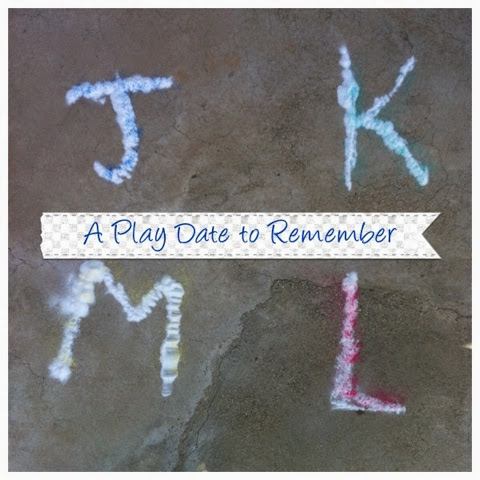
As always the first thing you need to do is prepare the area. This can be done by pouring the bicarbonate of soda onto the the floor, into 4 letter shapes, but you could do more depending on the age and stage of development of the child. I chose the letters J,K,M and L. Older children can also help out at this point by making their own letters.
                            
To add another dimension, interest and possible colour recognition to the letters, I took a blunt knife and scraped it along the side of the chalk, making the coloured dust fall on the letters.
                            
Before Bee was invited to play the game, I filled a spray bottle 3/4 of the way with vinegar and the rest with water. The activity was then ready.

Bee was curious as to what we were going to do. I explained that we were going to play the fizzy letter game. I would ask her what the initial letter of the words, jump, kick, mum and love were. Once she guessed the letter correctly she could squirt it with the vinegar and water solution. Not only was this activity promoting letter recognition but Physical skills too, as she would try squeeze the trigger on the spray bottle and aim with precision at the letters. 
                                 
At first Bee was surprised at how the liquid bubbled and fizzed. She commented on it being "fizzy like lemonade" and how the letter began to disappear once she had squirted a lot of liquid on it. She also noticed change of state as the powder changed to a fizzing liquid.
                                 

When all the letters had been washed away, Bee asked could she draw er own picture, who was i to pass up an important child initiated activity?! It seemed that she had been watching closely as she made a pattern on the floor with the bicarb, scraped the chalk like i did and squirted it. She seemed fascinated by the way her picture fizzed as it disappeared.
                  
What did we learn?
  • Communication and language-Speaking and listening. Talking about what we are seeing and what will happen next
  • Physical development- Fine manipulative skills as she learns how to squeeze the trigger on the spray bottle. Hand eye coordination and precision when aiming the spray at the letters. 
  • Personal, social and emotional- joining in with a game and listening to the rules. Making relationships. Fun and enjoyment. self help skills and independence 
  • Literacy- Linking sounds to letters, learning how to read and write. Segmenting words so that she can find the initial letter.
  • Mathematics- making patterns and developing concepts of space and measurement. 
  • Understanding of the world- Experimenting with the bicarbonate of soda and vinegar solution. Predicting what will happen next
  • Expressive arts and design- Designing her own picture with the bicarbonate of soda


What could be done next?

  • For children who prefer visual clues, you could use objects and ask your child to guess the initial letter of the object.
  • Add scents such as vanilla, peppermint and almond essence to the vinegar solution, this will create a sensory experience
  • The purpose of this activity could be changed, so that instead of developing letter recognition you could promote shapes, numbers or even colours.
  • Try making the sidewalk chalk or fizzy volcano pictures that are mentioned above.


Monday, May 19, 2014

Father's Day cards

Last weekend was Mother's Day in America and my friend Nina gave me the inspiration for these cute Father's Day cards (Although the examples I have provided are for Granddad's) She told me that her child's school had asked her daughter a few questions on what her Mum liked, how tall she was etc and wrote it down for her. I thought that this was a lovely idea and knew that Bee's Granddads back in the UK would just love them. I was also interested in what Bee would say when asked how tall she thought they were... the answers were quite funny.   
The card was really easy to make. All you need are paper and pens...simple, but lovely!    
            
                                   
Who can play?
If your child can hold a pencil, then this activity is for them. Even young children can mark make a drawing of their Dad/Granddad and maybe you could write down things that your Husband/Dad does with your child.

Safety:
Supervise young children with the writing equipment

What do you need?
  • Felt tip pens
  • Paper
  • Card
  • Glue
What did we do?

Firstly, I folded a piece of card in half. On the inside left I wrote the title, 'This is how I see you through my eyes Gramps' (this is the name Bee prefers for her Granddad) The statements about her Gramps were then wrote underneath:
  • You are...........tall
  • You are ....... years old
  • You weigh.....stone
  • You like to eat................
  • You like to drink.............
  • You like to watch............
  • You like to......................
The final things I had to prepare was the piece of paper that Bee was going to draw her Gramps on. This was done by cutting out a piece of paper, small enough to fit on the card and a slightly larger piece of blue paper to back the picture on.

I asked Bee to draw a picture of her Gramps. Even though I let Bee draw her own version of Gramps, we still talked about the body parts to draw, their positioning and counted eyes etc. I thought it was quite funny how she only gave him 2 strands of hair (as he is going quite fair on the top) See if you can spot the difference between her own drawing and the real Gramps.
Bee's drawing of her Gramps
Bee's gorgeous, playful funny and loving Gramps

Now for the fun part, during a quiet time of the day, I sat with Bee and we looked at a picture of her Gramps and we talked about him. I read each statement to her and asked her to tell me how tall etc she thought her Gramps was, 70 foot 3 is ginormous I know and obviously not his accurate size, but she was experimenting with numbers and making me laugh at the same time. Once she had told me her answer I would write them down in front of her, spelling the words out as I went along.
In the picture below you can see some of her other answers.
What I think of my Gramp's
The last thing that we had to do was to sign the card. I think that the name frame we have been practicing with, over the past week or so, have been helping Bee with keeping the letters of her name in one line.
                                
Love from...
Here is the final product...                                

Final product
I know my Dad (Bee's Gramps) will just love this card and it will make him giggle. Hope you like it just as much too.

What did we learn?
  • Communication and language-Speaking and listening. Talking about her Gramps
  • Physical development- Fine manipulative skills and hand eye coordination when holding her pen to write and draw
  • Personal, social and emotional- Making relationships and recalling happy memories with her Gramps. Pride from finished product and increased self esteem.
  • Literacy- Linking sounds to letters, learning how to read and write
  • Mathematics- Shapes, space, measurement and counting body parts when drawing her Gramps.
  • Understanding of the world- learning about her family unit
  • Expressive arts and design- Drawing her Gramps and designing her own card
What could be done next?
  • Instead of putting the picture and statements on a card, you could also add them to a frame, perfect for giving away as a present
  • The cards can be adapted to any time of the year, for example mothers day, religious celebrations or even a birthday
  • If you have older children who are able to write, allow them to fill in the blanks instead of you. This will encourage writing for a reason.


Wednesday, May 14, 2014

Letter eating robot

To help your child become familiar with letters and stay away from the dull method of repeating flash cards, turn an old shoe box into a letter eating robot!
'Metal Mike', to give him his real name was used a lot during my time working with reception/kindergarten children and the children seemed to enjoy playing with him.
You can download the Metal Mike mask from Sparklebox or if you are creative draw your own. 
In Great Britain we use the Dfes Letters and Sounds Document within State schools and the private sector, as a tool to help learn phonics through exciting and fun activities. You can find lots of similar activities on their website featured above.

Metal Mike ready for his alphabet lunch

Who can play?
Children aged two years plus, depending on their age and stage of development. At first they can just experiment looking at the letters and posting them. As they grow older and skills increase they will begin to name the letters.

Safety
Supervise children at all times.

What do you need?

  • Shoe box
  • Glue
  • Cello tape
  • Scissors
  • Metal Mike print out or pens and paper to draw your own.
  • Letter flash cards or letters wrote on card. You could even use magnetic letters
What did we do?
To prep the activity I downloaded the Metal Mike picture from the website Sparklebox UK. I would like to keep this for a long time, so I chose to laminate it, however it will work just as well if you cut it out and glue it onto the front of the box. I then proceeded to cut out a small rectangle where his mouth was so that Bee can post her letters through.


To make sure we have access to the letters once they have been posted through his moth, I cut the lid of the box in half and cello-taped it to the back of the box.

The back of the box

Now for the fun part...playing with the letter eating robot.
First of all I told Bee that Metal Mike was really hungry and all that he fancied eating today was letters. Bee laughed and said "OK mummy, I can help him" Picking up the letters that she recognised, she began saying their names and posting them in his mouth. After each letter she would say "Is that yum Metal Mike?" I would reply in a robot voice "Th-a-t was y-u-m!" introducing word segmenting.
We went over the letters she was unsure of and posted them together whilst making eating noises when the letters went in.

This activity led us into talking about words that begin with certain letters such as c for cat. As we posted in the letter c we would say "c-a-t" I also introduced the use of robot arms when segmenting the words (moving your arms up and down alternatively when saying a letter in the word). This is used as a visual tool to help the child recognise the individual letters.

Metal Mike and his letters were placed on the shelf in Bee's playroom, for further child initiated play.

What did we learn?
  • Communication and language-Speaking and listening. Talking like a robot, adjusting the way she talks and segmenting and blending words
  • Physical development- Fine manipulative skills when picking up and posting letters. Large manipulative when making robot arms. Coordination and hand eye development.
  • Personal, social and emotional- Making relationships, social skills, learning about feelings,fun and enjoyment and taking turns
  • Literacy- Linking sounds to letters, learning how to read and letter recognition
  • Mathematics- Space, measurement and capacity. 
  • Understanding of the world- Talking about robots and how they work
  • Expressive arts and design- Pretending to be a robot and becoming involved in role play.
What could be done next?

  • Use the Metal Mike cut out as a mask. Your child could hold it up to their face and blend/segment. 
  • Introduce a guessing game, for example what is Metal Mike spelling.
  • Instead of using letters, you could use colours, numbers and shapes, depending on which one you think your child will enjoy the most.
  • To encourage writing skills you could leave paper and pencils next to the robot, to provide an opportunity for your child to either write a letter for him or draw a picture.


Wednesday, May 7, 2014

Name frame

Ever since Bee (my daughter) started to draw pictures, I encouraged her to mark make/write her name at the top of her picture. This was not only so that I could tell it was her creation, but to also encourage pre-writing skills and make meaningful marks on paper. Over the past few months Bee has been writing recognisable letters that feature in her name. During free play she tends to write the letters on the paper in the order that they occur in her name, but just not in the correct sequence or in a line (from left to right) 

Bee attempting to write her name.
I remembered using letter frames when working as an Early Years Practitioner in a mainstream school. Miss Fair, an amazing, inspirational teacher introduced them to me, when planning a phonics session. Normally they are used to write CVC words (consonant, vowel consonant) but, I am going to use them to encourage Bee to write the letters of her name in order.

Who can play?
Children aged 3 years plus, depending on their age and stage of development.

Safety:
Supervision of children is advised at all times. 

What do you need?
  • Paper
  • Pen/pencil
What did we do?
To begin with I wrote Bee's name on the top of a piece of paper for reference. She could also go over it if she wanted to have a practice writing the letter. Underneath her name I placed a frame that had 8 sections big enough to write the letters of her name (in order)

The name frame

If your child is still learning how to form the letters in their name, you could always add a their name in the frame by making dots for them to go over.

Name frame with dots to help with letter formation
All that was left to do then, was to support and guide Bee in writing the letters of her name in the correct order in the boxes.  


Even though she wrote her letter 's' going in the other direction, she did write all her letters in the correct order.


We will continue practicing using the name frame and eventually, with a little bit of practice she will be able to do this without the frame.                          

What did we learn?
  • Communication and language- Talking about the letters that feature in her name and the order in which we write them down.
  • Physical development- Fine manipulative skills and hand eye coordination when attempting to write her name.
  • Personal, social and emotional- Accepting support and help from others. Developing an awareness of her own name.
  • Literacy- Linking sounds to letters, learning how to read and write. Learning the letters in her name and their formation.
  • Mathematics- Spacial awareness when attempting to write letters in the boxes and counting how many letters feature in her name. Sequencing the letters.
What could be done next?
  • Laminate the name frame so that you can use them again and again
  • Hide letters around the house/garden that feature in your child's name. Once they have been found, they have to organise them in the name frame


Wednesday, April 2, 2014

Mark making in salt

Finding getting your child interested in writing letters a challenge? Have you tried writing with something other than a pencil and paper? Why not try salt writing. The only things you need are salt, a tray and fingers.
This month Bee will be experiencing activities to develop her letter formations. As you know children get easily bored when sitting at a table,with a pen and paper. A hands on activity will capture their creativity and keep them on task for longer. When working in a UK state school we used the Letters and Sounds document composed by the department of education and skills. The document provided tools to teach children high quality phonics, by using hands on experiences and activities.
Once they have finished creating their literacy masterpiece, just give the tray a gentle shake to begin the experience once again.

Who can play?
Children aged 2 years plus. Depending on their age and stage of development.

What do you need?
  • Tray
  • Salt
  • Fingers
Safety:
Discourage children from eating the salt, as this can make them sick.

What did we do?
Salt was placed on a serving tray and gently shaken to spread it out evenly. Paper was placed on the floor to protect it and a brush and shovel placed close by, for little spills. The area was prepared  whilst Bee was at preschool, so as soon as she came home she came straight to the activity.
 She had lots of questions such as "what is this?" "what do you do?" showing a lot of interest. I suggested that she could experiment with the salt first, make marks and then we would go on to attempt to write some letters by using the correct formations.
By using her pointer finger she began swirling it around in the salt, making circles, patterns and people. 
Once she had covered the tray with her marks, I showed her how to carefully shake the tray back and forth to smooth the salt, so she could write on it again.
 After about three times of exploring the salt on her own, we talked about some of the letters she knew. Bee said that her favourite was S as it looked like a snake. To start her off I made some dots in the salt in the shape of a letter S. Bee followed the direction of the S over the top of the dots, going from the top to the bottom.


She then attempted to draw her own S.


We did this with the letter a, o, c and f. To add a bit of humor, I made some nonsense words up such as c o f f and wrote them in the salt with dots for her to follow. Once she had joined the dots together, we blended the letter sounds together to sound out the word. Bee thought that this was funny and we had to write more words, which she 'traced' over.


The salt was then placed in a Tupperware container, so that it can be used in another activity.

What did we learn?
  • Communication and language-Asking questions,talking about what they are doing and listening to instructions.
  • Physical development- Fine manipulative skills when using pointer finger to write in the salt. Large manipulative skills when shaking the tray. Hand-eye coordination.
  • Personal, social and emotional- Developing self help, when shaking the tray by themselves.Pride form finished product.
  • Literacy- Linking sounds to letters, learning how to read and write and letter formations.
  • Mathematics- Shapes, space and measurement.
  • Expressive arts and design- Pattern making and being creative.
What could be done next?

  • Substitute the salt for glitter
  • Add tools such as small brushes or cotton buds to use to mark make.
  • Place paint on a tray and write in it. Paper can be placed on the top to take a print of the writing.